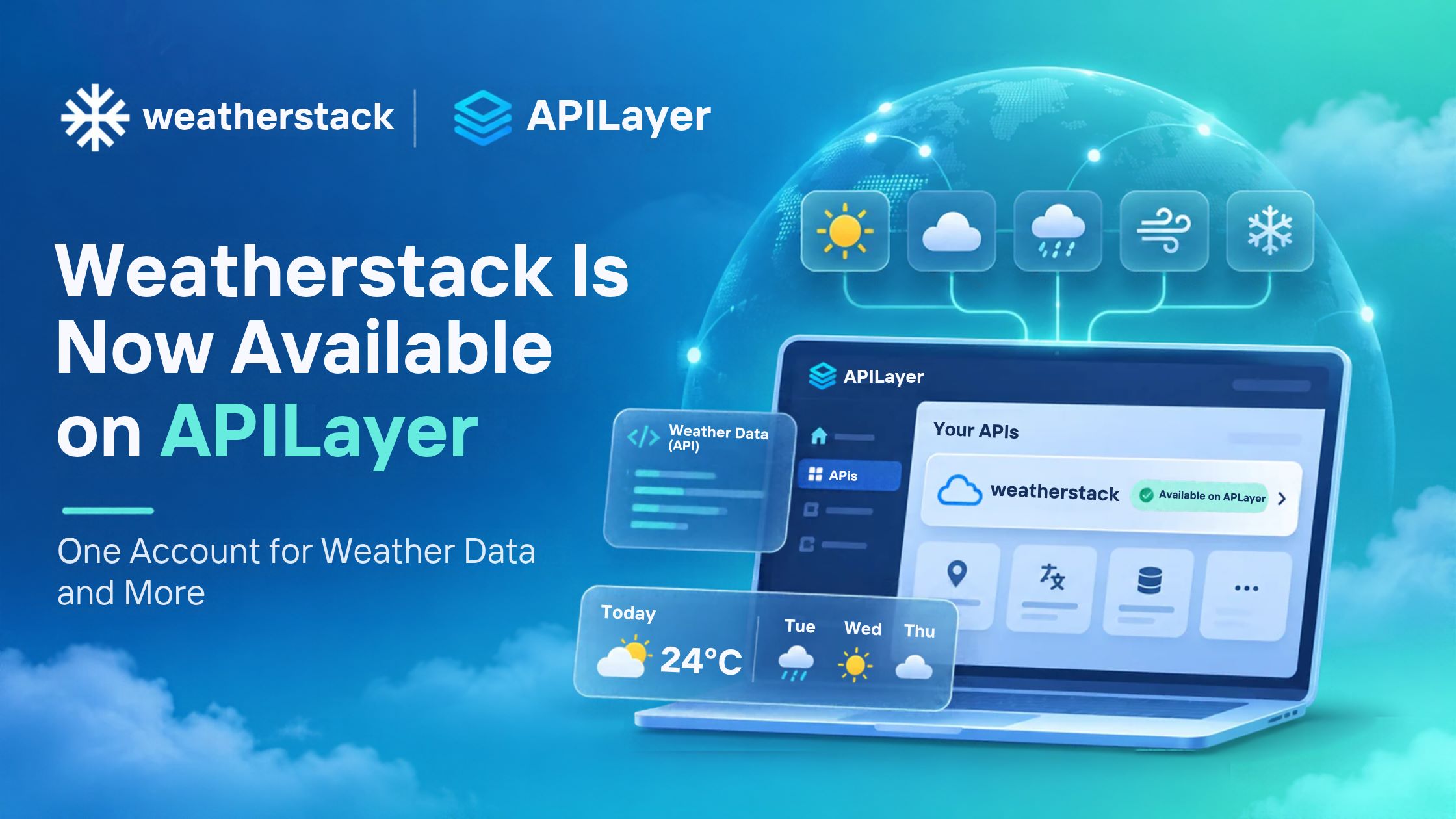

Weatherstack joins APILayer, giving developers one account to manage weather data APIs, subscriptions, usage, and billing.
AUSTIN, TX, UNITED STATES, November 27, 2026 /EINPresswire.com/ — Weatherstack is now available on APILayer, bringing real-time weather conditions, historical data, forecasts, marine weather, and more into a unified API ecosystem.
Live on APILayer since October 22, 2026, Weatherstack offers the same weather data capabilities developers already rely on, with a new way for customers to sign up, manage their API usage, and access complementary APIs through one account.
What’s new with Weatherstack on APILayer?
Weatherstack is now accessible through the APILayer ecosystem, where developers can manage multiple API services from one dashboard.
The existing Weatherstack features and endpoints remain available, including:
– Real-time weather: Retrieve current weather conditions for locations worldwide.
– Historical weather: Access past weather observations for supported locations and dates.
– Weather forecasts: Integrate forecast data into applications that need upcoming weather information.
– Marine weather: Access weather information relevant to marine conditions and applications.
-Location lookup: Find locations to use in weather queries.
-Bulk weather lookups: Request weather data for multiple locations in a single call.
No existing features or endpoints have been removed as part of this release. Weatherstack’s core functionality remains unchanged.
One APILayer account. More possibilities.
Weather data often forms one part of a larger application. A travel platform, for example, may need weather forecasts across several destinations, while a logistics application may combine weather information with location data to support its operations.
With Weatherstack on APILayer, developers can discover and manage complementary APIs alongside their weather data integration.
Here’s what the APILayer ecosystem offers:
– One account: Access Weatherstack and other subscribed APILayer APIs without managing separate accounts for each service.
– One API key: Use a single APILayer API key across the APIs enabled in your account.
– One dashboard: Monitor API usage and manage subscriptions in one place.
– One bill: Manage billing for your APILayer API subscriptions through a consolidated account experience.
For instance, a location-aware application could combine Weatherstack for weather information with Positionstack for geocoding. Both services can be managed through the APILayer ecosystem, helping developers expand their applications without adding unnecessary account-management complexity.
Each API retains its own subscription and usage allowances.
What changes for existing Weatherstack users?
If you already have an account on Weatherstack.com, no action is required.
You can continue logging in through it and using your current API key, subscription, and integrations. Your existing endpoints and API functionality remain unchanged.
For new customers, Weatherstack sign-up now takes place through APILayer. Once registered, you’ll use the APILayer dashboard to manage your API key, usage, and subscription.
Existing Weatherstack accounts are not being migrated as part of this release. Customers will receive advance notice before any account migration.
Weatherstack plans on APILayer
Weatherstack’s pricing remains unchanged, with two plan names updated on APILayer:
– Standard is now Starter.
– Business is now Enterprise.
The available APILayer plans are:
– Free Plan: 100 requests at no cost.
– Starter Plan: 50,000 requests for $9.99.
– Professional Plan: 300,000 requests for $49.99.
– Enterprise Plan: 1,000,000 requests for $99.99.
Developers can select a plan based on their application’s expected usage and required weather data capabilities.
How to get started
Getting started with Weatherstack through APILayer is straightforward:
1. Visit Weatherstack on APILayer.
2. Create an APILayer account and select a Weatherstack plan.
3. Access your API key through the APILayer dashboard.
4. Review the Weatherstack documentation to configure your first request.
5. Start integrating weather data into your application.
New customers should follow the APILayer documentation for the appropriate authentication and request format. Existing Weatherstack customers can continue using their current integration setup.
Documentation and changelog
The Weatherstack documentation is available on APILayer, with Quickstart, Getting Started, API Features, and endpoint reference sections.
– Weatherstack API documentation
– APILayer changelog
– Weatherstack on APILayer
Get started with Weatherstack on APILayer
Whether you’re adding live weather conditions to an application, retrieving historical weather data, or building experiences that combine multiple data services, Weatherstack is now part of the APILayer ecosystem.
Explore Weatherstack’s capabilities and discover how other APILayer APIs can support your next project.
Explore Weatherstack on APILayer
Emiliano Trozzi
APIlayer
+1 512-226-8080
marketing@apilayer.com
Visit us on social media:
LinkedIn
Instagram
Facebook
YouTube
X
Other
Legal Disclaimer:
EIN Presswire provides this news content “as is” without warranty of any kind. We do not accept any responsibility or liability
for the accuracy, content, images, videos, licenses, completeness, legality, or reliability of the information contained in this
article. If you have any complaints or copyright issues related to this article, kindly contact the author above.

Media gallery