The Falcon-2020CRS is a 20MP Color USB 3.2 Gen 1 Camera built on the Onsemi AR2020 sensor, and Vadzo is positioning it for counter-drone applications. A small drone at long range occupies very few pixels, flies against a bright sky, and may arrive at dusk or after dark, so the camera that watches it is limited by resolution, contrast, and light all at once. The Falcon-2020CRS puts more pixels on a distant target, keeps excellent response in the near infrared at 850nm and 940nm for illuminated night work, and offers eDR and HDR modes for bright skies and dark subjects. Wake on motion lets a remote node rest between events. The module connects over a standard USB 3.2 Gen 1 cable and carries an S-Mount lens holder. Designed for integrators building counter-drone systems, it supplies the visual layer that confirms and tracks what other sensors report.
FORT WORTH, TX / ACCESS Newswire / October 21, 2026 / Vadzo Imaging, a provider of embedded vision camera products for OEMs and system integrators, today positions the Falcon-2020CRS 20MP Color USB 3.2 Gen 1 Camera for counter-drone applications. Built on the Onsemi AR2020 sensor and part of Vadzo’s USB camera portfolio, the Falcon-2020CRS combines 20MP resolution, excellent low-light performance, excellent near-infrared response at 850nm and 940nm, eDR and HDR modes, and wake-on-motion in a UVC-compliant module. With this positioning, Vadzo presents a 5K Color USB 3.2 Gen 1 Camera for visual detection, verification, and tracking of small, unmanned aircraft, together with guidance on pixels on target, frame rate planning, and night illumination for integrators who build counter-drone systems.
20MP Color USB 3.2 Gen 1 Camera for Counter-Drone Detection
Small unmanned aircraft are hard to see. A typical quadcopter is a few tenths of a meter across, flies at tens of meters per second, and appears against the sky, which is the brightest and most featureless background a camera can face. At a distance of several hundred meters, such an aircraft covers only a handful of pixels on a conventional camera, and the detection software has very little to work with. Every pixel counts, and so does every photon, because a target that small has almost no contrast to spare. Designers who plan for all three from the start avoid most of the surprises that appear during site trials.
Three physical limits shape the design. The first is angular resolution. The number of pixels on a target depends on the pixel pitch, the lens focal length, the target size, and the range, and a long lens narrows the field of view as it increases the pixels on target. A sensor with more pixels allows a wider field for the same detail, which means fewer camera units to cover a sector. The second limit is dynamic range. A dark aircraft silhouette against a bright sky is a high-contrast scene, and a camera exposed for the sky may render the target as a dark smudge or lose it in glare. The third limit is light. At dusk and at night, a camera needs sensitivity to see anything, and near-infrared illumination can extend the range, but only if the camera responds to the wavelength the illuminator uses. A camera that lacks that response gains nothing from the lamp.
Frame rate and shutter behavior add further constraints. A 20MP high-resolution camera frame is large, and the interface limits how many frames arrive each second. A fast target crossing the view needs enough frames to be followed, so resolution and frame rate must be balanced. A rolling shutter reads the image row by row, and a fast-moving target can appear skewed, which matters when software estimates direction and speed. Remote installations raise a power question as well, since a node on a mast or a solar supply cannot stream video continuously. A module that lists a high pixel count without addressing these constraints leaves the integrator to discover them in the field, where changes are costly and slow.
The camera also plays a limited role. It does not replace radar or radio frequency sensing, which detect aircraft at greater range and in poor visibility. The camera confirms what other sensors report, classifies the target, and tracks it, and the legal and operational rules for responding to a drone belong to the integrator and the operating authority. Vadzo supplies the imaging module and the engineering guidance, and it leaves operational decisions to those who carry the responsibility.
Exploring the Capabilities of Falcon-2020CRS 20MP Color USB 3.2 Gen 1 Camera
The Falcon-2020CRS is built on the Onsemi AR2020, a 20MP (5120 x 3840) color rolling shutter sensor with a 1/1.8 inch optical format and 1.4 micron pixels. The sensor is a low-noise CMOS design that supports enhanced dynamic range, an HDR mode, excellent low-light and near-infrared sensitivity, and wake-on-motion. Vadzo has validated the near-infrared response at both 850nm and 940nm. This makes the module an AR2020 NIR Sensitivity USB Camera in the sense that matters to a counter-drone designer, because the response is confirmed at the resolution and wavelengths the system will use. Many modules are tested only at low resolution or in visible light, which says little about the high-resolution near-infrared case.
A worked example shows why resolution matters. The angle covered by one pixel equals the pixel pitch divided by the focal length. With 1.4 micron pixels and an example lens of 12 mm focal length, one pixel covers about 0.117 milliradians, and the horizontal field of view is about 33 degrees. A drone 0.3 meters across at 500 meters subtends about 0.6 milliradians, which is roughly five pixels. At 1000 meters, the same drone covers about 2.6 pixels. These numbers are illustrative and depend on the lens chosen. They show how quickly the target shrinks with range, and how a high pixel count lets a designer choose a wider field of view for the same pixels on target. Detection generally needs fewer pixels than classification, so the required count depends on the task. Teams can use the same calculation to compare lenses and to decide how many camera units each sector needs.
The interface and frame rates set the other side of the trade-off. In USB 3.2 Gen 1 mode, the module supports a range of video modes. The full 20MP mode reaches 5 frames per second in YUYV and 10 in MJPEG. The 13MP mode reaches 10 and 20. The 4K mode reaches 15 and 30. Full HD reaches 60 in both formats. A designer can therefore run a wide area scan at 20MP for detail, then switch to a lower resolution mode with a region of interest when a target appears and tracking needs more frames. The module also supports dynamic ROI, gain and exposure control, and anti-flicker settings. On a USB 2.0 port, the rates drop sharply, so a USB 3.2 Gen 1 host is recommended. Cable quality also matters, and certified cables avoid many intermittent faults on masts and roofs.
The sensor handles contrast through enhanced dynamic range and an HDR mode. A dark aircraft silhouette against a bright sky is exactly the kind of scene where a wider dynamic range keeps the target visible while the sky stays unclipped, and the right mode depends on how extreme the contrast is. Teams should test both on their own sky and background conditions. For night work, the module’s response at 850nm and 940nm lets it use near-infrared illumination. 850nm is received more strongly, while 940nm is invisible to the eye, and both extend range only as far as the illuminator’s power allows. Wake on motion lets the module rest at low power and return to capture when the scene changes, which suits remote nodes, though clouds and birds can cause false wakes. A short trial at the real site shows how often that happens and how far the threshold can be raised.
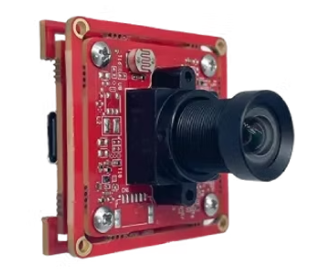
The module is UVC compliant, uses a rolling shutter, and connects through a USB Type-C connector. It draws between 1.05 W and 1.75 W at 5 volts, operates from minus 30 degrees C to 70 degrees C, measures 38 mm by 38 mm, is convertible to 30 mm by 30 mm, and weighs 13 grams without the lens. A GPIO connector provides one digital input and one digital output at 1.8 volts, and Vadzo can enable additional lines through its customization program. The module uses an S-Mount (M12) lens holder. Distant targets sit effectively at infinity, so a fixed focus lens set for infinity is a natural fit, and Vadzo helps teams choose the focal length for their required field of view. A longer lens raises pixels on target and narrows the view, so some sites pair several camera units with different lenses.
Product Overview
The Falcon-2020CRS is a 20MP color USB module built on the Onsemi AR2020 sensor and positioned for counter-drone applications. As an AR2020 Counter Drone USB Camera, it is built for integrators who need as many pixels on a distant target as a single USB connection can carry. The module houses the sensor, image processing, and a USB 3.2 Gen 1 controller in a compact board with an S-Mount (M12) lens holder. As a 20MP eDR USB Camera, it uses enhanced dynamic range to keep a dark target visible against a bright sky, and as a 20MP Low Light USB Camera, it keeps sensitivity for dusk and night scenes. The 20MP NIR Color USB Camera designation confirms its excellent response at 850nm and 940nm. The module also serves as a 5K NIR class camera in the sense that its 5120 x 3840 frame offers about five thousand pixels across, and as a 4K NIR USB Camera when run in the 4K mode at higher frame rates.
Key Capabilities: Falcon-2020CRS 20MP Color USB 3.2 Gen 1 Camera
Key specs: 20MP (5120 x 3840) Max Resolution | Onsemi AR2020 1/1.8-inch Sensor Format | 1.4-micron Pixel | Color with Rolling Shutter | USB 3.2 Gen 1 Type C Interface | S-Mount (M12) Lens Holder
Pixels on Target for 20MP Drone Detection USB Camera
More pixels let a camera either widen its field of view or keep more detail on a distant target. As a 20MP Drone Detection USB Camera, the Falcon-2020CRS gives designers room to choose, covering a sector with fewer camera units or placing more pixels on an aircraft at a given range. The module also supports a dynamic region of interest, so software can follow a target in a smaller window at a higher frame rate. Vadzo recommends calculating pixels on target for the real lens and range before choosing, since detection and classification need different pixel counts. A simple spreadsheet with the pixel pitch, focal length, target size, and range usually settles the question.
Excellent NIR Response at 850nm and 940nm
Night operation depends on how well the camera uses its illuminator. As a 5K NIR Sensitive USB 3.2 Gen 1 Camera, the module responds well at both 850nm and 940nm, which lets an integrator use the band that suits the site. Illumination at 850nm is received more strongly but may show a faint red glow, while illumination at 940nm is invisible to the eye and returns less signal. Either band extends the range only as far as the illuminator power allows, and the illuminator, its eye safety, and its supply remain the integrator’s responsibility.
eDR and HDR for High-Contrast Sky Imaging
A dark aircraft against a bright sky is a high contrast scene. Enhanced dynamic range and HDR modes keep the target visible without letting the sky wash out the frame. As an AR2020 eDR Low Light USB Camera, the module lets teams choose the mode that suits the contrast of their site, using eDR for moderate contrast and HDR for extreme cases. Recording the same sky with each mode, at several times of day, is the quickest way to decide. Choosing the mode is a software setting, so teams can change it as seasons and backgrounds change.
Excellent Low Light Performance for a 4K Low Light USB Camera
Dusk and night scenes demand sensitivity. The sensor’s low-noise design and 1.4-micron pixels, combined with its near-infrared response, make the module a 4K Excellent Low Light USB Camera when run in 4K mode, and a full 20MP camera when detail matters more than speed. Teams should still plan supplementary illumination for dark sites, because no sensor creates light that never arrives, and they should test at the real hour and in the real weather. Haze, rain, and low cloud all change what a camera can see at range.
Wake on Motion for Remote Anti-Drone USB Camera Nodes
Remote nodes on masts, roofs, and solar supplies cannot stream continuously. Wake on motion lets the module rest at low power and return to capture when the scene changes, which makes it a practical Anti Drone USB Camera for remote positions. Clouds, birds, and moving foliage can trigger false wakes, so teams should tune the threshold at the real site and consider cueing the camera from a radar or radio frequency sensor instead of relying on motion alone. A cue from another sensor can also reduce the wake time, since the camera is ready before the target arrives.
USB 3.2 Gen 1 Integration and OEM Support
The module connects to any USB 3.2 Gen 1 host port on Windows or Linux and enumerates as a UVC device with no proprietary driver. Vadzo recommends certified USB 3.0 Gen 1 or higher cables and short cable runs. As a 20MP Color USB Camera Manufacturer, Vadzo supports lens matching, firmware customization, GPIO enablement, and enclosure design, and teams can move from evaluation to volume with the same module and documentation. Teams that need a custom lens or additional GPIO behavior can discuss it with Vadzo early in the project.
“Counter drone work is a numbers game. A small aircraft at long range covers very few pixels, and it sits against the hardest background there is. We positioned the Falcon-2020CRS around three things that help. It offers 20 million pixels, so a designer can put more pixels on the target or widen the field of view. It has eDR and HDR modes for the contrast between sky and silhouette. And it responds well at 850 and 940 nanometers for night work. We are also direct about the limits. A camera does not replace radar or radio frequency sensing, and the number of pixels needed depends on the task, so we encourage customers to calculate pixels on target for their own lens and range.” – Alwin Vincent, Product Manager, Vadzo Imaging.
Counter-Drone Imaging Applications
Visual Verification with a 20MP Drone Detection Camera
Counter-drone systems usually combine several sensors, and the camera provides the visual layer. The Falcon-2020CRS works as a 20MP Drone Detection USB Camera that confirms what radar or radio frequency sensors report, shows an operator what the aircraft is, and tracks it across the sky. Its resolution lets the system keep detail on a distant target, and a wider field of view reduces the number of camera units needed to cover a sector. Operators can also record full frames for later review while the live display shows a cropped region.
5K Counter Drone NIR USB Camera for Dusk and Night Operation
Drones do not stop flying at dusk. The module serves as a 5K Counter Drone NIR USB Camera when paired with a near-infrared illuminator at 850nm or 940nm, giving the system a usable image after dark. Because the illuminator’s power sets the range, integrators should plan for the distances they need and verify them on site. Eye safety and local regulations for the illuminator remain with the integrator. Integrators who need long range at night should test with the real illuminator at the real distance before committing to a design.
Anti-Drone USB Camera for Remote and Power-Limited Nodes
Perimeter nodes on masts and roofs often run on limited power. The camera functions as an Anti Drone USB Camera that rests with wake on motion between events and returns to full capture when something enters the view. Teams should tune the threshold to avoid false wakes from birds and clouds, and consider cueing from other sensors. Solar-powered sites in particular benefit from a camera that rests between events.
Multi-Sensor Integration with Radar and Radio Frequency Systems
The most effective counter-drone installations combine sensing methods. Radar and radio frequency detectors cover wide areas and poor visibility, while a camera confirms, classifies, and tracks. The Falcon-2020CRS connects over standard USB and the UVC interface, so it fits compact computers running tracking software, and a GPIO line can signal external equipment. The integrator remains responsible for the legal and operational rules that govern any response to an unmanned aircraft.
Related Uses of the 20MP Color USB Camera
The same properties serve other fields. A Smart Surveillance 20MP Camera and a Smart Surveillance eDR USB Camera suit wide area monitoring where contrast is high. A Quality Inspection 20MP Camera and a Quality Inspection NIR USB Camera suit fine inspection under controlled illumination. A Medical Device NIR USB Camera and a Medical Device Low Light Camera suit instruments that image under dim or invisible light, and device makers remain responsible for performance claims and the regulatory pathway of the finished device.
Frequently Asked Questions About Counter Drone USB Camera Systems
Q: How many pixels does a camera need on a small drone to detect it?
A: There is no single number, because detection and classification need different amounts of detail. Detection can work with only a few pixels on the target, while telling one aircraft type from another usually needs more. Vadzo Imaging suggests calculating pixels on target from the pixel size, lens focal length, target size, and range. A 20MP Drone Detection USB Camera gives more room to widen the field of view or keep detail at distance, and Vadzo Imaging helps teams choose the lens, because the right focal length depends on the range the system must cover.
Q: Why does near infrared help a camera watching for drones at night?
A: A camera that responds to near-infrared light can use an illuminator the eye barely notices, which lets it see in the dark. A 5K Counter Drone NIR USB Camera responds at 850nm and 940nm, the two common illuminator bands. The illuminator’s power limits the range, and 940nm returns less signal than 850nm but is invisible. Vadzo Imaging recommends measuring the achieved range on the real site, since power and weather both matter, and a trial at night with a real drone is the most convincing test.
Q: Is a camera enough for counter-drone defense?
A: No. Radar and radio frequency sensors detect aircraft at greater range and in poor visibility, and a camera confirms, classifies, and tracks what they report. Vadzo Imaging designs its camera modules as the visual layer in a multi-sensor system. The legal and operational rules for responding to an unmanned aircraft belong to the integrator and the operating authority, so teams should review them before designing a system, and Vadzo Imaging supports that planning with evaluation units.
Q: Why is dynamic range important when watching the sky for drones?
A: A dark aircraft against a bright sky is a high contrast scene. A camera exposed for the sky may turn the target into a dark smudge, and a camera exposed for the target may blow out the sky. A 20MP eDR USB Camera widens the range so both stay readable. Vadzo Imaging suggests recording the same sky at several times of day in each mode to choose the best setting, using the same lens and mounting as the final installation.
Q: Why should integrators choose Vadzo Imaging as their 20MP Color USB Camera Manufacturer?
A: Vadzo Imaging offers more than a camera module built around a capable sensor. Integrators working with Vadzo Imaging receive a module validated for excellent near-infrared response at 850nm and 940nm, with eDR and HDR modes and wake-on-motion, along with candid guidance on pixels on target and the limits of a camera in a counter-drone system, plus engineering support for lens selection, firmware customization, and enclosure design. Vadzo Imaging maintains evaluation kits with no minimum order requirement, so teams can test on their own site before committing to volume production.
Availability
The Falcon-2020CRS 20MP Color USB 3.2 Gen 1 Camera built on the Onsemi AR2020 sensor is available now for evaluation and production orders. Evaluation kits include the camera module, an S-Mount lens, and platform documentation, with no minimum order requirement. Integration teams can calculate pixels on target for their own lens and range, test eDR and HDR against their own sky, and confirm night range with their own illuminator before committing to a production bill of materials, which tells them more than a datasheet comparison alone. Teams that need a different focal length can ask Vadzo to review the configuration. Browse the full range of USB camera options at Vadzo’s website or discuss OEM integration requirements for counter-drone and related programs.
About Vadzo Imaging
Vadzo Imaging is a global provider of embedded vision solutions and delivers high-performance camera technologies and imaging platforms for applications in robotics, industrial automation, UAVs, edge AI, and medical systems. Its products are designed for seamless integration with leading embedded platforms. Vadzo supports customers through hardware customization, firmware development, and module-level drivers, enabling faster development and deployment of vision-based systems across USB, MIPI, GigE, Wi-Fi, and SerDes camera interfaces.
Media Contact
Alwin Vincent
Vadzo Imaging
Email: alwin@vadzoimaging.com
LinkedIn: Vadzo Imaging
YouTube: Vadzo Imaging
X: Vadzo Imaging
SOURCE: Vadzo Imaging
View the original press release on ACCESS Newswire
Media gallery