The Bolt-521CRS is a 5MP Color MIPI CSI-2 Camera built on the Onsemi AR0521 sensor, and Vadzo has validated its low-noise imaging on the RK3588 Rockchip processor. Noise decides how useful an embedded image is. It hides detail in dim scenes, confuses detection models, and inflates the bitrate of recorded video. Where that noise gets controlled matters as much as how much of it there is, because a raw sensor module leaves denoising, color processing, and tuning to the host, and the result depends on how well the host was tuned. The Bolt-521CRS takes a different route. Large 2.2-micron pixels gather more light, and an on-board image signal processor applies denoising, color correction, and auto exposure inside the module, so the host receives a finished YUV image. As a Low Noise Embedded Camera, it delivers Full HD at up to 60 frames per second and 5MP at up to 30 frames per second. Designed for smart surveillance, warehouse robotics, and medical and life science devices, this RK3588 Compatible MIPI Camera gives embedded teams a clean, consistent image on Rockchip, Raspberry Pi, and NVIDIA platforms.
FORT WORTH, TX / ACCESS Newswire / October 15, 2026 / Vadzo Imaging, a provider of embedded vision camera products for OEMs and system integrators, today announces validation of low-noise imaging on the Bolt-521CRS 5MP Color MIPI CSI-2 Camera, a color camera built on the Onsemi AR0521 sensor and confirmed for the RK3588 Rockchip processor. Part of Vadzo’s MIPI camera portfolio, the Bolt-521CRS pairs a 5MP sensor with large pixels and an on-board ISP, giving embedded developers a module that delivers a clean, finished image without host-side tuning. With this validation, Vadzo delivers a 5MP Low Noise MIPI Camera for smart surveillance, warehouse robotics, and medical and life science devices, supported by two adapter board variants for 2-lane and 4-lane MIPI CSI-2 hosts and by documented integration with Raspberry Pi and NVIDIA platforms.
Technical Problem Definition: Why a Low Noise Embedded Vision Camera Needs a Finished Image
Noise is the quiet limit of embedded vision. In bright scenes, it is invisible, but vision devices rarely stay in bright scenes. Warehouse aisles are dimly lit, security systems watch at night, and medical instruments image small areas under controlled but modest light. In those conditions, the signal is weak, and the noise is relatively strong. Noise hides fine detail, makes edges unstable, and confuses detection and recognition models that depend on clean input. It also raises the bitrate of recorded video, since random speckle is hard to compress, which increases storage and network cost for every unit in the field. Even small differences in noise add up across a fleet of devices that record continuously.
Where the noise is handled turns out to matter a great deal. Raw sensor modules send unprocessed data to the host, which must then demosaic, correct color, reduce noise, and manage exposure. On a Rockchip platform, that work is done by the host image signal processor, which needs careful tuning for each sensor and lens. Good tuning takes time and expertise, and two products built on the same processor can look very different depending on how well each was tuned. Teams that lack that expertise often accept noisier images than the sensor is capable of, and teams that have it spend weeks of engineering effort that could have gone into the application. For a small team, the difference between tuning an ISP and building the product can decide whether a project ships on time.
A second problem appears when a product must run on more than one platform. A design that works on a Rockchip board may need to run on a Raspberry Pi or an NVIDIA development kit for evaluation or for a different customer. If image processing lives on the host, each platform produces a slightly different image, and models trained on one may behave differently on another. A Low Noise Imaging Camera that finishes the image inside the module removes that source of variation, because every host receives the same processed output. Teams that evaluate on one board and deploy on another benefit most.
Teams that choose a module without thinking about this tend to discover it late, when the hardware is built, and the images look worse than expected. Returning a host ISP, changing the sensor, or moving processing around at that stage is expensive and slows launch. Choosing a module with finished output at the start avoids most of that risk.
Engineering Explanation: Clean Image MIPI Camera Behavior on the AR0521 Sensor
The Bolt-521CRS is built on the Onsemi AR0521, a 5MP (2592 x 1944) color rolling shutter sensor with a 1/2.5 inch format and 2.2 micron pixels. Pixel size is the first lever on noise. A larger pixel collects more photons in a given exposure, and in dim scenes the arrival of photons is itself a source of noise that improves as the signal grows. The AR0521 uses a back-illuminated pixel structure that improves light collection further. The result is an AR0521 MIPI Camera that starts from a stronger signal, which is the most effective way to reduce noise before any processing. Choosing a 5MP format on 2.2 micron pixels is also a deliberate balance, since a sensor with far more pixels of the same size would need a larger, more expensive optical format.
The on-board ISP is the second lever. It converts the Bayer sensor data into a finished image, performing debayering, demosaicing, color correction, contrast correction, gamma correction, denoising, and lens corrections, and it supports automatic functions such as auto exposure and auto white balance. Camera controls exposed to software include brightness, exposure, contrast, sharpness, saturation, gamma, gain, white balance, and denoising, with anti-flicker for 50Hz and 60Hz lighting. Because this processing happens in the AR0521 Camera Module itself, the host receives a YUV422 image at 8-bit or 10-bit depth that is already processed. Denoising always involves a trade-off, since strong filtering softens fine detail, so the denoising control lets integrators set the balance that suits their application. Teams can start from the default and adjust it while watching real scenes, which is the most reliable way to find the right setting.
The module is a two-board solution, with the camera module board and an adapter board. The adapter comes in two variants, one for 2-lane MIPI CSI-2 and one for 4-lane. The 2-lane variant connects directly to Raspberry Pi and NVIDIA Jetson development kits, while the 4-lane variant provides the bandwidth for faster frame rates. In 4-lane mode, the supported video modes run at 120 frames per second at VGA, 60 at HD, 60 at Full HD, and 30 at the full 5MP resolution. Teams should match the lane count to the host connector and the frame rate they need. The connector types differ between the two adapter boards, so the choice should be made when the carrier board is designed.
On the host side, the module has been integrated with Raspberry Pi, NVIDIA Nano, and NVIDIA Xavier NX-based solutions, and Vadzo has validated it for the RK3588 Rockchip processor. Because the camera outputs finished YUV, the RK3588 can send frames directly to its video encoder or to AI inference without first running its own ISP on raw data. Teams that want raw access and full control of tuning would choose a raw sensor module, and Vadzo offers those as well. The module draws between 0.80 W and 1.45 W at 3.3 volts, operates from minus 30 degrees C to 70 degrees C, measures 38 mm by 38 mm, is convertible to 32 mm by 32 mm, and weighs 8 grams without the lens. Humidity is rated at 20 to 80 percent relative, non-condensing, and two status LEDs show whether the module is powered with no streaming or actively streaming.
Product Overview
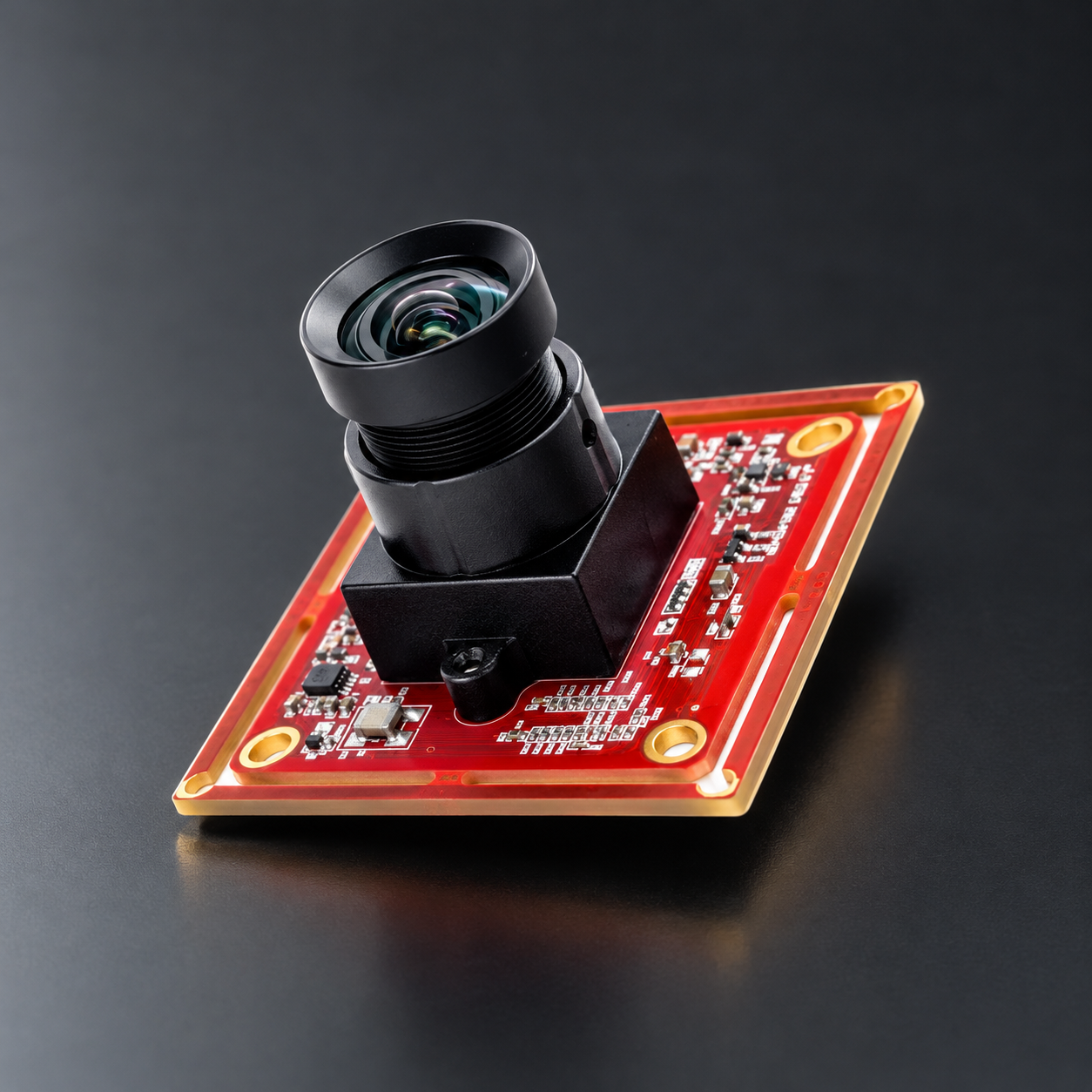
The Bolt-521CRS is a Full HD capable MIPI module built on the Onsemi AR0521 sensor and validated for low noise imaging on the RK3588 Rockchip processor. As a 5MP low-noise MIPI Camera, it is built for embedded teams who want a clean image without host-side noise tuning. The module combines the sensor, an on-board ISP, and an S-Mount lens holder with a 74 DFOV lens, and it connects over 2-lane or 4-lane MIPI CSI-2. As an RK3588-compatible MIPI Camera, it sends finished YUV frames to the RK3588, and as a low-noise color camera module, it delivers consistent color and low noise on every supported host. The 5MP Color MIPI Camera Module designation covers the full 2592 x 1944 resolution at up to 30 frames per second in 4-lane mode. It also serves as a 5MP Color Camera Module and an AR0521 Camera Module for designs that need the sensor with finished output.
Key Capabilities of the Onsemi AR0521 Low Noise MIPI CSI-2 Camera Module
Key specs: 5MP (2592 x 1944) Max Resolution | Onsemi AR0521 1/2.5 inch Sensor Format | 2.2 micron Pixel | Color with Rolling Shutter | 2 Lane and 4 Lane MIPI CSI-2 Interface | S-Mount (M12 Standard) Fixed Focus Optics with 74 DFOV Lens
Low Noise Imaging Camera Performance from 2.2 Micron Pixels
Noise starts at the pixel. As a low-noise imaging camera, the Bolt-521CRS relies on 2.2-micron pixels that gather more light than smaller pixels on a higher-resolution sensor, which gives a stronger signal in dim scenes before any processing. A stronger signal means less gain is needed to reach a usable brightness, and less gain means less amplified noise. For many embedded tasks, a clean 5MP frame serves better than a noisier image with more pixels. Teams that need more detail can crop within the frame, and teams that need cleaner images can reduce resolution for faster frame rates. Low light behavior also improves when the exposure time can be lengthened, which is possible when the subject moves slowly.
On-Board ISP for Consistent Color and Denoising
The on-board image signal processor finishes the image inside the module. It performs debayering, demosaicing, color correction, contrast correction, gamma correction, denoising, and lens corrections, and it adds auto exposure and auto white balance. Every unit therefore delivers the same processed output regardless of host, which keeps color and noise behavior predictable across a production run. The host receives YUV422 frames and does not need to run its own ISP on raw data, which saves tuning time and processor load. Integrators who want a different balance can adjust denoising, sharpness, gamma, and other controls through software. Anti-flicker settings for 50Hz and 60Hz lighting also help in stores, warehouses, and clinics with fluorescent or LED fixtures.
RK3588 Rockchip Processor Integration for an Embedded Camera for RK3588
Vadzo has validated the module for the RK3588 Rockchip processor, so it works as an Embedded Camera for RK3588 designs from the first day of evaluation. As a MIPI Camera for Rockchip Boards, it delivers finished YUV to the camera interface, and the RK3588 can pass frames to its video encoder or to AI inference directly. As an RK3588 Camera Module, a Rockchip MIPI Camera, and a Rockchip Camera Module, it avoids the weeks of host ISP tuning that raw sensor modules usually require. Teams that need raw data or custom tuning should discuss a raw sensor option with Vadzo instead. For most teams, though, a finished image from the first day shortens the path to a working prototype.
Raspberry Pi, NVIDIA Nano, and NVIDIA Xavier NX Platform Support
The same module has been integrated with solutions based on Raspberry Pi, NVIDIA Nano, and NVIDIA Xavier NX. The 2-lane adapter board connects directly to Raspberry Pi and NVIDIA Jetson development kits, which lets teams prototype on familiar hardware and then move to a Rockchip design without changing the camera. As a 5MP CSI-2 Camera Module with consistent finished output, it helps keep images comparable across platforms, so a model trained on one host behaves similarly on another. Evaluation on a Raspberry Pi or NVIDIA kit therefore predicts Rockchip behavior more reliably than it would with raw modules.
Full HD and 5MP Streaming in a Color MIPI Camera Module
Many embedded applications run at Full HD, and the module streams Full HD at up to 60 frames per second in 4-lane mode. As a Color MIPI Camera Module, it also streams HD at 60, VGA at 120, and full 5MP at 30 frames per second. Teams can choose the mode that suits the task, using Full HD for fast tracking and 5MP when detail matters. Because the module outputs finished YUV, switching modes does not require any change to host-side image processing, and the same application code works at each resolution. Video comes in YUV422 format, and still images can be captured as BMP files through a software trigger. The software trigger suits applications that capture a still on demand, such as a scan or a documentation image.
2 Lane and 4 Lane Integration as an Embedded Camera Module Manufacturer Offering
The two board designs give OEMs a clear choice. The 2-lane adapter suits Raspberry Pi and Jetson development kits, and the 4-lane adapter provides the bandwidth for faster frame rates. The module is small at 38 mm by 38 mm, convertible to 32 mm by 32 mm, and light at 8 grams without the lens, with a 3.3 volt supply drawing 0.80 W to 1.45 W. As an Embedded Camera Module Manufacturer, Vadzo supports lens matching, firmware customization, and enclosure design, and its Low Noise Embedded Vision Camera range gives teams a path from evaluation to production with the same documentation. OEMs moving from a development board to a custom carrier keep the same camera and the same image behavior.
“Embedded teams keep telling us that noise is where projects lose time. A raw module on a Rockchip board needs host ISP tuning, and the result depends on how much time the team can spend on it. The Bolt-521CRS was validated to remove that burden. Large pixels gather more light; the on-board ISP applies denoising and color processing inside the module, and the host receives a finished image that looks the same on a Rockchip, Raspberry Pi, or NVIDIA platform. We are also clear about the boundary. If a team needs raw data and full control of tuning, we have raw sensor modules for that. For everyone else, a clean finished image from the first day of evaluation is worth a great deal.” – Alwin Vincent, Product Manager, Vadzo Imaging.
Application Specific Sections: Low Noise Embedded Camera Systems in Practice
Smart Surveillance MIPI Camera for Day and Night Recording
Smart surveillance devices record around the clock, and noise at night raises the bitrate of recorded video and the rate of false alerts. The Bolt-521CRS works as a 5MP Smart Surveillance MIPI Camera for day and night video recording, smart parking, and pedestrian safety, and the datasheet also lists facial recognition and iris recognition among its application areas. Low-noise images give recognition models cleaner input and reduce storage costs. Night scenes and close-range recognition tasks may need supplementary illumination and an optics review, and Vadzo encourages teams to evaluate performance on their own scenes. Operators can also tune denoising to suit their recording policy, trading a little fine detail for smaller files where storage is limited.
Warehouse robotics MIPI camera for Scanning and Obstacle Detection
Warehouse robots read labels, scan objects and documents, and detect obstacles in aisles that are often dim. The module serves as a 5MP Warehouse robotics MIPI camera for object scanning, document scanning, OCR, and obstacle detection, with finished YUV output that lets a compact host spend its power on perception. At 5MP and 30 frames per second, or Full HD at 60, teams can choose between detail for reading and speed for navigation. Because the lens is fixed focus, the working distance should be matched to the task during evaluation. Integrators who need autofocus or a different field of view can ask Vadzo about lens options.
Medical Device MIPI camera for Medical and Life Science Devices
Medical and life science instruments image small areas under controlled lighting, where clean color matters for review. The Bolt-521CRS can serve as a 5MP Medical Device MIPI camera in ophthalmology, intraoral, dermatoscope, digital microscope, and pathology devices, the application areas listed in its datasheet. A compact 38 mm board and an 8-gram weight suit handheld and head-mounted instruments. Device makers remain responsible for performance claims, safety, lighting, and the regulatory pathway of the finished device, and Vadzo supports them with evaluation units and engineering guidance. Color accuracy under the instrument’s own light source should be verified during evaluation, since illumination strongly affects the result.
Frequently Asked Questions
Q: What does low noise mean for an embedded camera module?
A: Vadzo Imaging explains it this way: every image carries some random variation that hides detail, and a Low Noise Embedded Camera keeps that variation small relative to the useful signal. Two things drive it. Larger pixels gather more light, and on board processing can reduce noise without softening the image too much. A Clean Image MIPI Camera helps detection models, keeps recorded video smaller, and makes dim scenes usable. Vadzo Imaging recommends comparing modules in the same dim scene instead of relying on a single number, using the same lens, light level, and settings for every candidate.
Q: Why does an on-board ISP matter when connecting a MIPI camera to a Rockchip board?
A: An on-board ISP finishes the image inside the module, so the host receives processed frames and does not need to demosaic, correct color, and denoise raw data itself. On a Rockchip platform, this saves host ISP tuning time, which can take weeks, and keeps the image consistent from unit to unit. A MIPI Camera for Rockchip Boards with finished output suits teams that prefer a ready image. Teams that want raw access for custom tuning can ask Vadzo Imaging about raw sensor modules.
Q: Should a MIPI camera use 2 lanes or 4 lanes?
A: It depends on the host connector and the frame rate you need. A 2-lane connection suits Raspberry Pi and NVIDIA Jetson development kits and keeps wiring simple. A 4-lane connection carries more data, which allows faster frame rates, such as 5MP at 30 frames per second. Vadzo Imaging offers both adapter variants for its 5MP CSI-2 Camera Module, so teams can match the lane count to the platform and change it later without changing the camera board, which protects the investment in lens and enclosure design.
Q: Is Full HD or 5MP better for embedded vision?
A: Full HD runs faster and carries less data, which suits fast tracking, navigation, and live streaming. Five megapixels offers more detail, which suits reading small text, inspecting fine features, or cropping into regions of interest. A Color MIPI Camera Module that supports both lets a team use each where it fits. Vadzo Imaging recommends testing on the real task, because the right choice depends on how small the target is and how fast the scene changes.
Q: Why should OEMs choose Vadzo Imaging as their Embedded Camera Module Manufacturer?
A: Vadzo Imaging offers more than a camera module built around a capable sensor. OEMs working with Vadzo Imaging receive a module with a documented on-board ISP, validated integration across Rockchip, Raspberry Pi, and NVIDIA platforms, and honest guidance on when a raw sensor module is the better fit, plus engineering support for lens selection, firmware customization, and enclosure design. Vadzo Imaging maintains evaluation kits with no minimum order requirement, so teams can test low noise performance on their own hardware before committing to volume production.
Availability
The Bolt-521CRS 5MP Color MIPI CSI-2 Camera built on the Onsemi AR0521 sensor is available now for evaluation and production orders. Evaluation kits include the camera module, the 2-lane or 4-lane adapter board, and platform documentation, with no minimum order requirement. Engineering teams can compare noise performance in their own dim scenes, confirm frame rates on their own RK3588 hardware, and test the on-board ISP controls before committing to a production bill of materials, which tells them more than a datasheet comparison alone. Teams that need a different lens or adapter configuration can ask Vadzo to review the setup. Evaluation also lets teams confirm the status LED behavior, the lane configuration, and the GPIO situation, since the two GPIO lines on this module are not connected by default. Browse the full range of MIPI camera options at Vadzo’s website or contact Vadzo at support@vadzoimaging.com to request an evaluation unit or discuss OEM integration requirements for smart surveillance, warehouse robotics, and medical and life science programs.
About Vadzo Imaging
Vadzo Imaging is a global provider of embedded vision solutions and delivers high-performance camera technologies and imaging platforms for applications in robotics, industrial automation, UAVs, edge AI, and medical systems. Its products are designed for seamless integration with leading embedded platforms including Rockchip, NVIDIA Jetson, Raspberry Pi, and NXP i.MX. Vadzo supports customers through hardware customization, firmware development, and module-level drivers, enabling faster development and deployment of vision-based systems across MIPI, USB, GigE, Wi-Fi, and SerDes camera interfaces.
Media Contact
Alwin Vincent
Vadzo Imaging
Email: alwin@vadzoimaging.com
LinkedIn: Vadzo Imaging
YouTube: Vadzo Imaging
X: Vadzo Imaging
SOURCE: Vadzo Imaging
View the original press release on ACCESS Newswire
Media gallery