
SHENZHEN, China – September 4, 2026 – Every driver knows the feeling: the car runs fine on Tuesday, and by Thursday it will not start. The fault was building long before the dashboard lit up. For years, car diagnostics could only read what had already broken. THINKCAR believes the next step is reading what is about to break — and its on-device AI agent, Tyler, is built to do exactly that: turn over 100 million diagnostic data records and cases into early warnings a driver can act on.
What “predictive” means here — and what it does not
A diagnostic code tells the driver what failed. A prediction shows what is drifting toward failure. Tyler’s Predictive Fault Analysis is mileage-driven: it looks at the vehicle’s current mileage, manufacture date, and the model’s recommended service intervals to calculate when the next service is due — by time or mileage, whichever comes first.
The function layers several signals. The Maintenance Mileage Alert automatically matches maintenance intervals and generates a Maintenance Timeline. The Historical Warning tracker records four alert types — Battery Health, Oil Change, Wiper Replacement, and Vehicle Maintenance — each moving through Pending, Email Sent, and Completed states. AI Report Analysis then reviews prior diagnostic reports, ranks fault priority as Top 1 or Top 2, and lists potentially damaged components and related DTCs with repair recommendations.
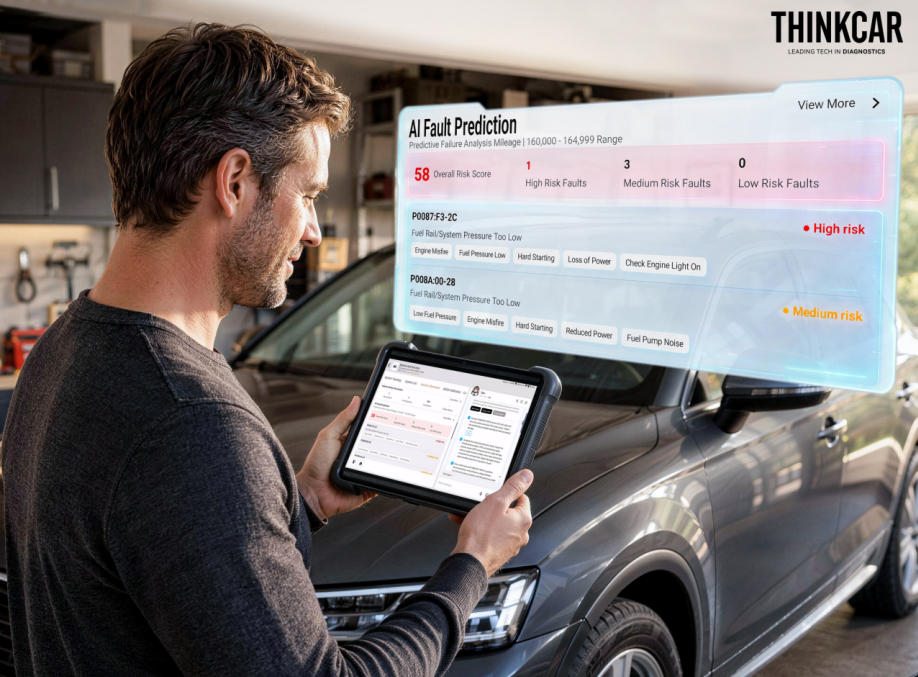
That data feeds into the Vehicle Information page, where Tyler displays maintenance status, safety status, predicted faults, and estimated value. The prediction is expressed as an overall risk score, broken into predicted high-, medium-, and low-risk faults. A driver or technician can tap View More to see the detailed fault information behind each score.
Tyler does not claim to know the exact day a part will fail, and it should not be read as a guarantee. What it offers is a risk reference: a ranked read on which systems show early signs of stress, drawn from a knowledge base of over 100 million diagnostic data records and cases and 48 million EPC records. THINKCAR’s AI engineering team is explicit that prediction is a probability, not a prophecy.
How Tyler reads the trend, not just the code
Under the hood, Tyler runs on ThinkMind, THINKCAR’s in-house diagnostic model, orchestrated by ThinkClaw across specialized sub-agents for system diagnosis, maintenance, and fault analysis. When a vehicle shows an intermittent fault — a misfire that clears, a sensor reading that drifts — Tyler compares it against the knowledge base: 375,000-plus repair flows sourced from Solera AutoData, 48 million EPC records. The match surfaces a ranked likelihood, not a single verdict.
AI reading complex signals to find faults is not a bet THINKCAR is making alone. In fields far from the repair bay, purpose-built AI already beats decades-old methods at forecasting what is coming and ranking what matters. In 2025, a Nature Scientific Reports study showed deep-learning models — a CNN-LSTM hybrid — predicting equipment failure and remaining useful life from real industrial sensor data at 96.1% accuracy and a 95.2% F1-score, beating older statistical methods across three factory datasets. That is predictive maintenance: the same principle behind Tyler’s mileage-driven fault warnings, applied to a CNC machine instead of a car. In weather, Google DeepMind’s GenCast — published in Nature in 2024 — issued probabilistic 15-day forecasts that beat the European Centre’s gold-standard ensemble on 97.2% of 1,320 test targets, on a single TPU in eight minutes instead of hours on a supercomputer; crucially, it returns a distribution of likely scenarios and their probabilities, the same risk-ranking logic Tyler uses to score a vehicle’s high-, medium- and low-risk faults. And in manufacturing quality, a 2025 Journal of Intelligent Manufacturing study used deep-learning models to monitor ultrasonic additive manufacturing in real time, catching defects above 97% accuracy and replacing slow manual inspection. The pattern is the one Tyler applies to a car’s future, not just its past: a purpose-built model reads the signals over time, ranks which systems are drifting toward failure, and hands back an early warning instead of a dead end.
From flicker to failure: a pattern
The classic case is an ignition coil on its way out. A basic reader logs the misfire code after it happens. Tyler, reviewing the same vehicle over time, can flag the coil’s degradation trend and mark it “watch this before it leaves the driver stranded” — turning an unknown into something a driver can plan around. That is the difference between a roadside tow and a Saturday-morning part swap.
What it is not
Prediction is a risk reference, not a substitute for a technician’s hands-on judgment when the job is physical. Maintenance, fault-prediction, repair-cost, and valuation results are provided for reference only.
Why early warnings pay off
Catching a fault as a trend, not an event, is where the payoff shows. Fewer surprise breakdowns mean fewer tow calls and less teardown to find the cause. In THINKCAR internal testing, Tyler’s predictive read lands within its target band on more than 85% of cases — a figure the team cites as internal testing, not a field guarantee. The point for a driver is simpler: problems caught early are cheaper and faster to fix.
THINKCAR also notes that the AI service is evolving. The company says ongoing data analysis and field learning will expand vehicle coverage, and build increasingly sophisticated fault-prediction models.
Which THINKCAR tools carry Tyler
Tyler is built into THINKCAR’s AI-enabled diagnostic tablet, the THINKCAR T394 AI, which will be available through authorized THINKCAR dealers.
“Drivers do not fear the light on the dash as much as the one that never came on in time,” said a THINKCAR product lead. “Tyler’s job is to move the unknown upstream — to turn a mystery into something you can schedule, budget, and fix on your terms. That is the whole point of putting an AI agent in the bay and in the driveway.”
The owner in the driveway and the technician in the shop face the same wall: more data than they can use. Tyler’s job is to hand back fewer questions and more answers.
You wrench. Tyler handles the rest.
Traditional code reader vs Tyler predictive
|
Traditional code reader |
Tyler (predictive) |
|
|
What it reports |
What failed — after the fault |
What is drifting toward failure — before it strands you |
|
Timing |
Post-event, reactive |
Early-warning, proactive |
|
Output |
A fault code |
A ranked risk reference plus an overall risk score (high / medium / low) |
|
Maintenance view |
None |
Maintenance Timeline; Historical Warning across Battery Health, Oil Change, Wiper Replacement, Vehicle Maintenance — each with Pending / Email Sent / Completed states |
|
Repair guidance |
The code alone |
Top 1 / Top 2 fault priority, potentially damaged components, related DTCs, and repair recommendations |
|
Role |
The baseline layer |
A layer on top of the code reader |
Frequently asked questions
Can AI-assisted diagnostic tools predict future vehicle problems?
Yes — within limits. Tyler reads patterns across over 100 million diagnostic data records and cases to surface early-warning risk references for systems showing stress. It is a ranked likelihood, not a guaranteed date.
How accurate is AI prediction compared with reading a code?
In THINKCAR internal testing, Tyler’s predictive read lands in its target band on more than 85% of cases; its diagnostic read on more than 95%. Both are internal-testing figures, not field guarantees.
Is predictive diagnostics better than manual code reading?
It is not a replacement for a code reader; it is a layer on top of it. A code says what failed; Tyler adds what is drifting toward failure, so the driver gets a heads-up instead of a surprise.
Does Tyler need internet or full coverage to predict?
Yes. Tyler’s predictions draw on connectivity and coverage; coverage gaps limit what it can forecast.
Which THINKCAR tools offer predictive AI?
Tyler will be available on the THINKCAR T394 AI through authorized dealers.
About THINKCAR
Founded in 2019, THINKCAR is a leading provider of AI-powered automotive diagnostic solutions. With AI patents and a nationally registered automotive AI algorithm, THINKCAR serves over 2.4 million users across over 215 countries and regions. Its product ecosystem spans 8 categories including diagnostic tools, TPMS, ADAS calibration, EV diagnostics, and remote service platforms.
The T394 AI, its flagship Tyler-powered tablet, will be available through authorized dealers — visit thinkcar.com for details. Separately, the THINKSCAN 689BT PRO and MUCAR 892BT PRO — a more affordable AI diagnostic lineup separate from the premium T394 AI — are sold online via mythinkcar.com
Sources & Methodology
“Over 100 million diagnostic data records and cases” and “48 million EPC records”: based on THINKCAR internal data.
“More than 85% predictive / more than 95% diagnostic accuracy”: based on THINKCAR internal testing; not a field guarantee.
“375,000-plus repair flows”: sourced from Solera AutoData.
“215+ countries and regions” and “2.4 million users”: based on THINKCAR internal data.
External benchmarks: Li et al., “Comparison of deep learning models for predictive maintenance in industrial manufacturing systems using sensor data,” Scientific Reports 15, 23545 (2025), DOI 10.1038/s41598-025-08515-z; Price et al., “Probabilistic weather forecasting with machine learning,” Nature (2024), DOI 10.1038/s41586-024-08252-9; Poudel et al., “Advanced Predictive Quality Assessment for Ultrasonic Additive Manufacturing with Deep Learning Model,” Journal of Intelligent Manufacturing (2025), DOI 10.1007/s10845-025-02582-9.
ThinkMind (model) and ThinkClaw (orchestration) are THINKCAR in-house technologies.
Product availability is subject to region; the T394 AI will be available through authorized dealers.
Media Contact
Company Name: THINKCAR TECH CO., LTD.
Contact Person: Jackie Lan
Email: Send Email
Country: China
Website: www.thinkcar.com


